
Oakland County Bench Warrants Explained
A bench warrant gets its name from the bench itself, because the judge signs it inside a case that is already open. Michigan uses that term instead of the capias label some other states carry. The trigger is usually a required appearance or a court-ordered step that simply did not happen. In Oakland County, the common triggers are a missed arraignment or hearing, a no-show at probation or a show-cause hearing, a failed payment plan, and a skipped support hearing. A traffic ticket can move through a civil-infraction default before any warrant question even comes up. What happens next depends on the charge and the court, so it pays to ask about the exact label on the order.
Oakland County Warrants and the 48-Hour Rule
Michigan Court Rule 6.103 gives a first-time criminal failure to appear a short window to fix it. The clock runs 48 hours and excludes weekends and holidays, after which a bench warrant can issue if the person has not appeared. Read it as an opportunity, not a promise. Case facts and exceptions matter a lot here. Oakland County courts do not treat this as a county-wide grace period, since a domestic or assaultive charge can follow a different path and a repeat failure carries its own consequences under the same chapter of the rules. Note: a missed court date does not always produce the same outcome, so ask the assigned court what its file shows.
How Oakland County Bench Warrants Are Issued
The judge signs the order once the court records the nonappearance or the compliance failure. From there the warrant enters the law-enforcement system. The sheriff's warrants unit validates it, confirming the name, the charge, and the court before a deputy acts. It stays open until the person appears, posts what the court requires, or the court recalls it. A court can also quash a warrant once the underlying problem is fixed, which is why the recall order is the document that matters at the end.
Oakland County Warrant Walk-Ins at 52-4
The 52-4 District Court in Troy publishes two bench-warrant walk-in blocks each weekday. They run 8:30 to 11:30 a.m. and 1:30 to 3 p.m., and the court says bonds must be posted in cash. That route is more specific than most Oakland County divisions offer, which is why the Troy page leads with the courthouse window rather than a general phone number. The court's own 52-4 District Court key information page states the hours and the cash rule. Before arriving, confirm same-day eligibility, the exact amount, and the case number at 248-528-0400.
Bench Warrants and Arrest Warrants Compared
In Oakland County, both orders let an officer take a person into custody. They just arrive from different directions.
| Feature | Bench Warrant | Arrest Warrant |
|---|---|---|
| Trigger | A missed appearance or court order | A complaint showing probable cause of a crime |
| Who issues it | The judge in the open case | A judge or magistrate reviewing an affidavit |
| Underlying case | An existing case the person skipped | A new or newly charged offense |
| How it clears | Appearance, bond, recall, or quash | Surrender, bond, or a court appearance |
The practical difference is the starting point. An Oakland County bench warrant sends you back to a case you already had.
Oakland County Support Warrants at FOC
A support bench warrant runs through the Circuit Court Family Division and the Friend of the Court, not a district court cashier. The FOC warrant line is 248-858-0479, open 7 a.m. to 5 p.m. on weekdays. A payer may walk in without an appointment to see a referee from 8:30 a.m. to 5 p.m., though the Wednesday window is shortened. Bring payment equal to the bond, plus a payment proposal or proof of employment. Local rules provide that a person arrested on an FOC warrant is brought before a referee at the county jail. The FOC electronic document submission tool is the filing side of that process, and it is limited to interested parties in a domestic-relations case.
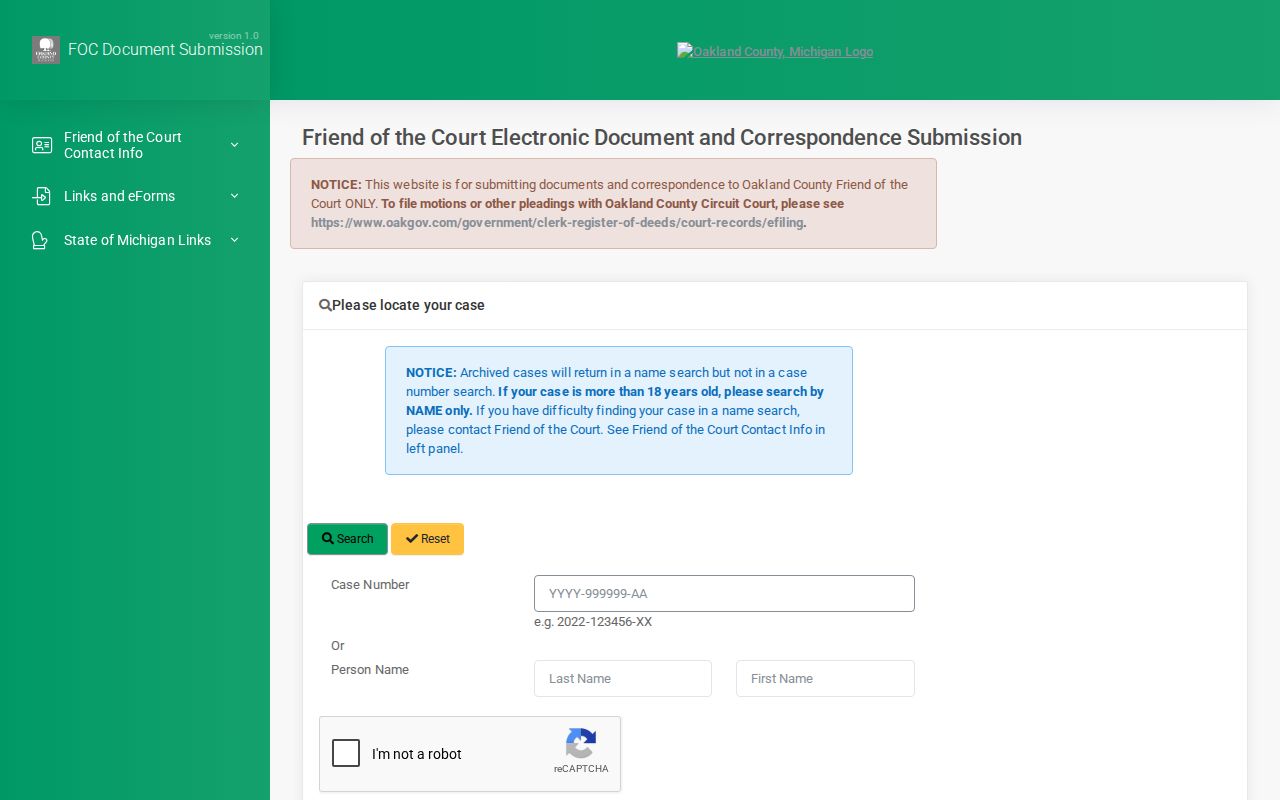
That portal's case-search fields and personal-use warning are exactly why a support warrant question in Oakland County ends with the FOC warrant line rather than an online lookup. Keep it off PayTix, too. The ticket system does not handle family enforcement.
Resolving an Oakland County Bench Warrant
Start with the court that set the case, not the agency that might serve it. In Oakland County, the issuing court decides the bond, the appearance, and the recall. Ask which window applies.
- Confirm the warrant and identify the court and case number.
- Ask the clerk about the walk-in or arraignment window, the bond, and the identification you need.
- Ask whether an attorney may appear or whether the court wants a motion to recall or quash.
- Complete the appearance, bond, or payment the court requires.
- Get the receipt, the order, and the next date in writing.
Caution: A bench warrant does not fade with time. Unpaid tickets and open warrants can stay active for years, and a police contact can lead to an arrest before you ever get to court.
Oakland County Warrants and Bond Forfeiture
Release terms follow the person forward. Under Michigan Court Rule 6.106, the court can revoke a release or move against the money or surety behind it when a defendant misses another required step. Payment forms are not uniform across the county. The 52-4 court asks for cash, the 50th in Pontiac accepts cash, certified check, or surety, and the 46th handles some non-felony matters online. A second failure can also bring a higher bond. Note: bond addresses the release condition, so the underlying case still needs its next appearance.
Finding the Court That Issued the Warrant
The court that opened the case controls its bench warrant, and only that bench can recall it. An Oakland County district warrant never clears at the sheriff's counter. Read the court name on your ticket, notice, or complaint. That tells you where the case lives. Then pull that docket in MiCOURT Case Search. A felony that began in district court moves to the Sixth Circuit after bind-over, so the district counter can no longer clear it. For a felony past that point, call the Sixth Circuit criminal clerk or the assigned judge's office, since Circuit bench-warrant arraignments run on the chief judge's daily calendar.
Proof After an Oakland County Warrant Recall
Get any Oakland County warrant recall in writing. Ask for a copy of the recall order or a stamped receipt. Write down who helped you. Then ask when the court record and the law-enforcement entry will both reflect the change. Fees vary. The 46th District Court charges a $20 motion fee when a formal filing is required, and other divisions set their own fees, so ask before you file. Keep the paperwork with your case documents rather than trusting a later portal search.